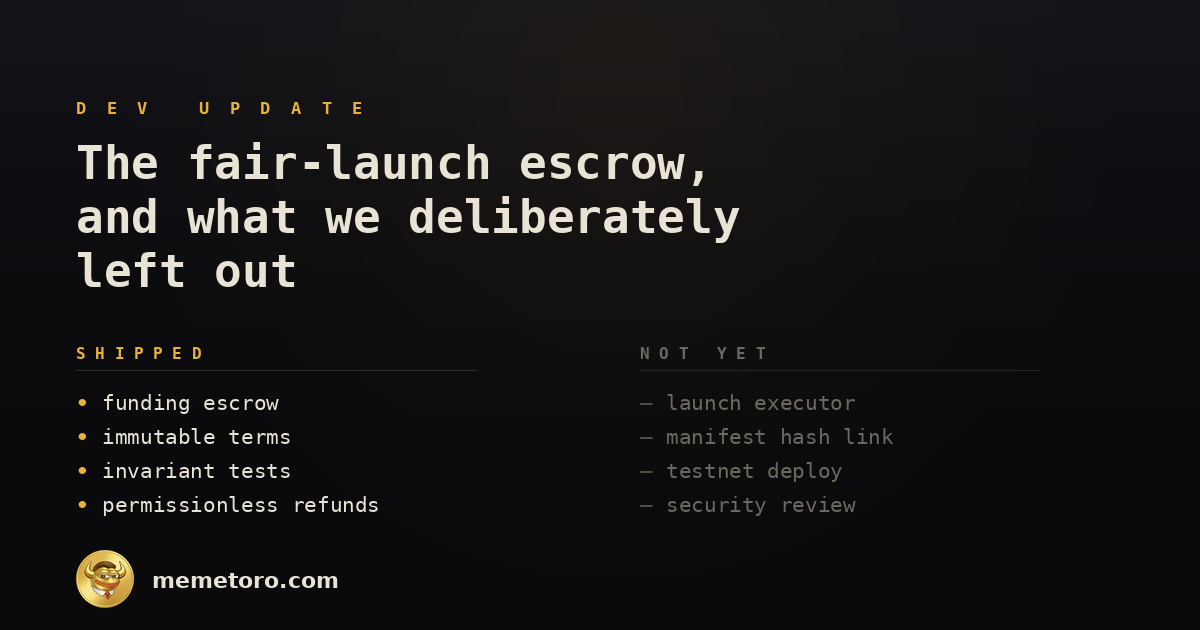
MemeToro’s dev update adds the contract that could execute launches proposed by its AI agent. The FairLaunchEscrow accepts contributions, applies fixed limits, and supports refunds or contributor claims.
Its most important crypto presale choices may be the features it leaves out. There is no owner, admin, upgrade path, or treasury withdrawal route inside this draft.
What the Crypto Presale Fair-Launch Escrow Is Designed to Do
The contract manages a funding round at a time. When it is created, it receives a manifest fingerprint, wallet cap, minimum and maximum targets, funding dates, finalization deadline, total token supply, two allocation percentages, and the address of a launch executor.
Each setting is stored as immutable data.
During the open window, a participant can contribute the network’s native coin. The contract rejects zero payments, late payments, amounts above the wallet cap, and contributions that would push the round over its hard cap.
It records each wallet’s outstanding amount and the total held.
If the minimum is reached, anyone can trigger finalization after the round ends, or earlier when the hard cap is filled. If the minimum is missed, contributors can request refunds.
Refunds also open after the finalization grace period if a qualifying launch is never completed.
These are useful building blocks for a crypto presale, but the current code is not a finished launch product. The real executor does not exist yet.
A mock executor lets the tests imitate token creation and claims without connecting to a decentralized exchange.
The draft remains separate from MemeToro’s current sale.
What MemeToro Deliberately Left Out of the Contract
The escrow has no owner or administrator. It contains no setter that can rewrite the funding limits, dates, supply, allocation split, executor, or manifest fingerprint after deployment.
It also has no upgrade route that can swap the original logic for a new version.
Several other absences narrow its power:
- There is no plain receive function that silently accepts uncredited payments.
- There is no path sending contributions to a founder, developer, or treasury.
- There is no third allocation bucket for insiders or private recipients.
- There is no backend-only function required for claims, refunds, or finalization.
This approach reduces the number of privileged actions that could be abused if a key were stolen. It also helps a crypto presale reviewer understand the contract because the escrow performs fewer jobs.
Money can return to its contributor or pass as a whole to the launch executor for liquidity.
The design does involve trade-offs. If immutable settings are wrong, an admin cannot correct them.
If the code contains a serious flaw, developers cannot patch the same escrow in place. MemeToro must therefore test each version carefully and deploy a new contract if the design changes.
The AI agent is kept outside fund custody. It may propose a launch and produce supporting evidence, but it cannot privately alter an active round.
Separating proposal generation from money movement is a core safety boundary for the future MemeToro presale platform.
What Was Deferred and Why It Still Matters
The ILaunchExecutor interface is only a plug-in point. The final implementation must deploy the token, provide decentralized exchange liquidity, define liquidity-provider token handling, and return the correct contributor allocation to the escrow.
Until then, claims work only against mock contracts in tests.
The contract accepts a manifestHash, yet the AI agent does not calculate that fingerprint through a standard serialization process. This means the published proposal and on-chain commitment are not connected end to end.
A canonical format must make the same manifest produce the same hash for every reviewer.
A factory and deployment scripts are also missing. These tools will help create rounds in a repeatable way and reduce mistakes when supplying constructor settings.
BNB Smart Chain testnet deployment, ERC-8004 agent identity, continuous integration, and an independent security review remain future work.
Deferring these pieces is reasonable in a first draft because each has its own risks. Pretending they already work would not be reasonable.
Every crypto presale article should state that the code is unaudited and not deployed anywhere.
This dev update is valuable because it defines a small, testable escrow before adding exchange logic. It does not prove that a live crypto presale is safe.
It gives outside developers a clear surface to inspect, challenge, and improve before real assets are involved.
FAQs
Why does the escrow have no owner?
Removing an owner prevents one privileged wallet from changing round terms or withdrawing funds through an owner-only function. That makes the stated limits structural.
It also means errors cannot be repaired through an admin action, so testing and review become even more important.
Where does contributed money go?
The draft permits two outcomes. Funds can return to the address that contributed them, or the entire raise can move to the launch executor during finalization.
The executor is intended to handle liquidity, but its real implementation is still unfinished.
Is the escrow ready for a MemeToro launch?
It is public, unaudited draft code with mocks for the missing executor.
Before any live crypto presale use, MemeToro needs the complete liquidity flow, manifest connection, factory, scripts, testnet work, and independent review. The AI agent and escrow are not connected yet.