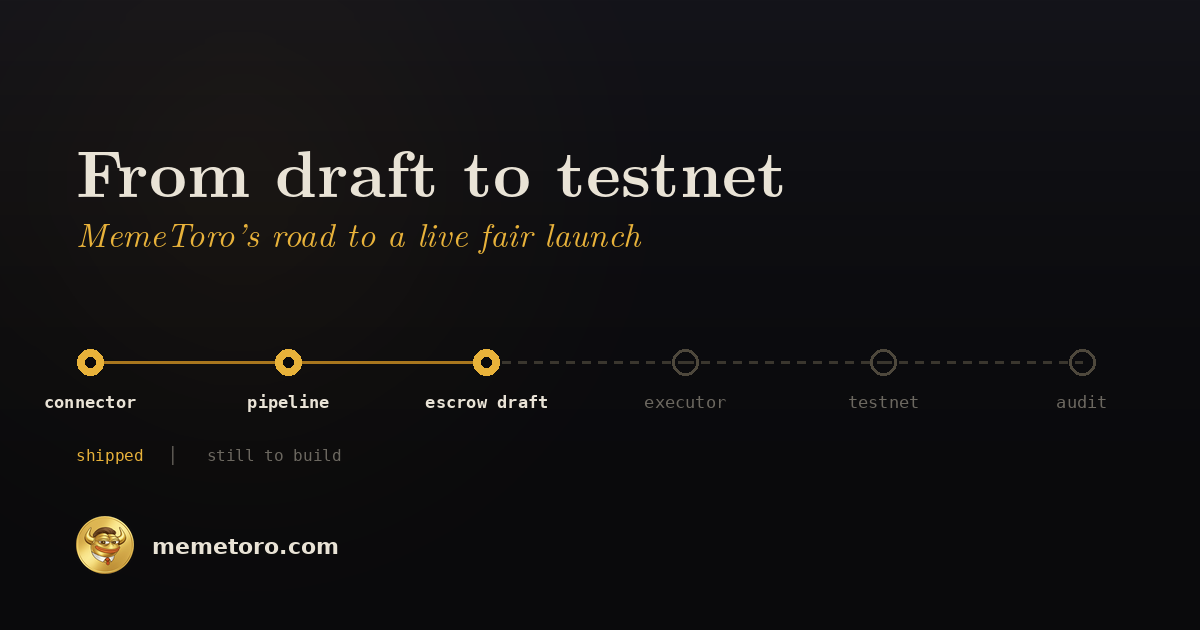
MemeToro has moved from describing fair launches to publishing its first escrow contract. That is a start, but it is not a live launch.
The code remains an unaudited draft and has not been deployed on any network. Reaching BNB Smart Chain testnet will require MemeToro to connect its AI agent, implement token and liquidity execution, add deployment tools, and test the complete flow.
Stage One: Build and Challenge the Public Draft
The first stage now exists. The September 7 commit added 1,373 lines across 17 files, led by FairLaunchEscrow.sol and a Foundry test project.
The escrow handles one funding round with fixed dates, thresholds, a wallet cap, token allocation rules, refunds, finalization, and proportional claims.
Its basic trust model is visible. There is no owner, admin, setter, or upgrade path.
Native funds can return to the contributor or pass to the executor for liquidity, but no function pays a developer or treasury. Contributor and liquidity shares must equal 100% of supply.
Tests now cover normal and hostile conditions. They examine deadlines, divided contributions, caps, failed transfers, bad executors, claims, refunds, and random sequences of actions.
Separate reachability tests confirm the suite can actually enter funded, launched, claimed, and refunded states.
Stage Two: Connect the AI Agent to Launch Execution
MemeToro’s AI agent can collect news and social signals, propose a memecoin idea, publish evidence and risks, and refuse unsuitable trends. Deterministic validation rejects unsupported URLs, allocation totals that miss 100%, and insider allocations above zero.
However, that proposal pipeline does not yet create the fingerprint stored by the escrow.
The MemeToro AI agent needs canonical manifest serialization. In simple terms, the same published manifest must always be converted into the same ordered data and the same manifestHash.
Users can then compare the off-chain document with the immutable fingerprint inside a round.
A working launch executor must:
- Deploy the correct token supply and fixed token rules.
- Send the contributor allocation back to the escrow for claims.
- Pair the remaining tokens and raised funds as liquidity.
- Define how liquidity-provider tokens are handled or locked.
- Fail safely without trapping contributor money.
This separation is intentional. The AI agent proposes; deterministic checks approve or reject the structure; smart contracts control funds.
No generated text should directly command a wallet holding crypto presale contributions.
Stage Three: Prove the Full Flow on BNB Chain Testnet
A factory and deployment scripts should come before repeatable testnet rounds. The factory can create escrows through one reviewed process, while scripts make configuration steps clear and reproducible.
Both need tests because an error in deployment inputs can defeat otherwise sound contract logic.
On BNB Smart Chain testnet, MemeToro can use valueless test assets to rehearse an entire round. Reviewers should be able to read the manifest, reproduce its hash, contribute from several wallets, hit or miss thresholds, trigger finalization, inspect liquidity, claim tokens, and recover refunds after failed outcomes.
The testnet should also show difficult cases. These include a broken executor, a token that fails transfers, a contribution over the hard cap, late payments, repeated claims, stalled finalization, and rounding at small contribution sizes.
Events and public balances should make each outcome traceable.
ERC-8004 identity can later connect a recognizable on-chain identity and reputation record to the AI agent. It should not replace contract checks.
Identity tells users which agent acted, while deterministic rules decide whether its proposal is structurally acceptable.
Stage Four: Review, Freeze, and Prepare for Production
An independent security review must examine the finished system, not only today’s escrow. Reviewers will need the executor, token logic, liquidity routing, factory, manifest process, and deployment settings.
Findings should be fixed, retested, and disclosed with clear version references.
Before a live fair launch, MemeToro should publish the reproduced hash, audit scope, resolved findings, and instructions for checking every item. Users should avoid addresses shared only through replies, private messages, or copied websites.
Immutability raises the standard for this stage. Once an escrow is deployed, nobody can upgrade it or correct its settings.
A new version requires a new deployment, so the reviewed bytecode and the live bytecode must match.
The path is still clearly unfinished: public draft, full implementation, testnet evidence, independent review, and only then production consideration. The MemeToro presale community can follow that progress without pretending each milestone proves the next one.
A live fair launch becomes credible through connected, repeatable evidence rather than one announcement.
FAQs
Is MemeToro already on testnet?
The official contract documentation says the escrow is not deployed anywhere.
BNB Smart Chain testnet deployment is listed as future work, along with the factory, deployment scripts, real executor, manifest connection, ERC-8004 identity, and security review.
What should a testnet launch prove?
It should prove the full path from a published AI agent manifest to its on-chain fingerprint, funding, liquidity execution, contributor claims, and refunds. It should also show that failed or delayed launches cannot strand funds or open conflicting outcomes.
When will the fair launch be ready for real funds?
No confirmed production date appears in this update. Readiness depends on completing the missing code, passing repeatable testnet trials, resolving an independent audit, and publishing verified deployment details.
Until then, the draft should never collect real crypto presale funds.