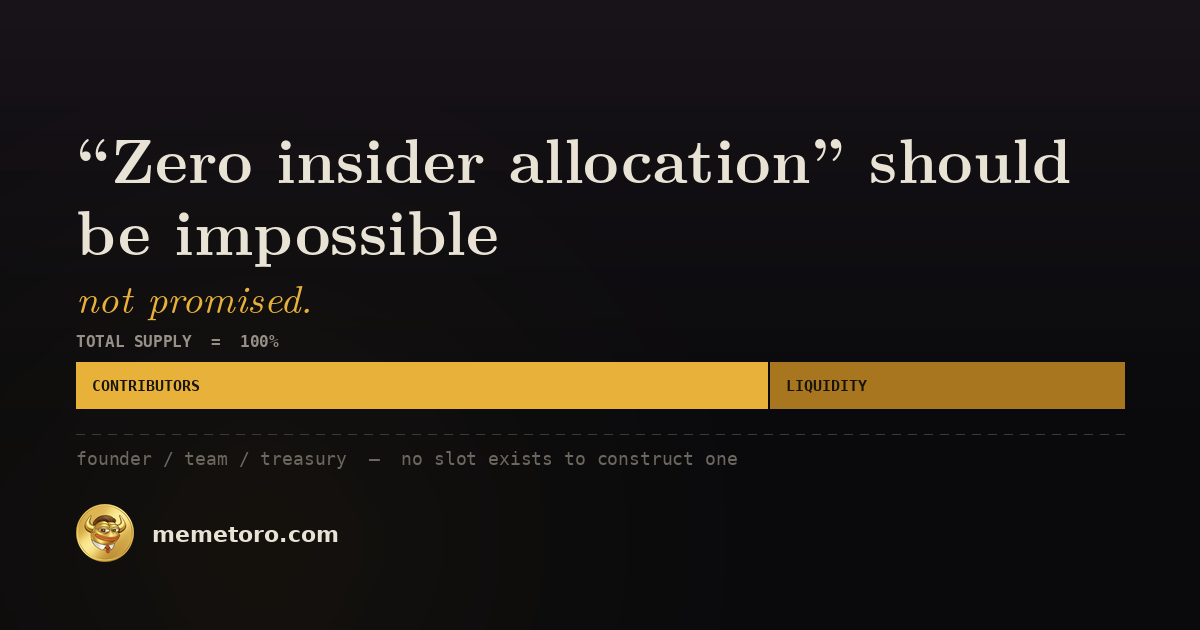
“Zero insider allocation” sounds reassuring on a crypto presale page, but words do not control token supply. A founder can publish one table and deploy different rules later.
MemeToro’s first fair-launch contract takes a stronger route: it only accepts a supply split between contributors and liquidity. The design aims to make an insider share impossible to represent, not merely unpopular or against policy.
A Promise Cannot Block an Insider Transfer
A crypto presale may promise a fair launch while leaving an owner with power to change allocations. Another project may call a wallet “ecosystem growth” even though one person controls it.
Buyers therefore need to compare the published tokenomics with the deployed contract and the first on-chain transfers.
MemeToro’s earlier AI agent pipeline already rejects a proposal when its allocation totals do not equal 100% or when insider allocation is greater than zero. That check protects the draft manifest.
The new FairLaunchEscrow adds a separate contract-level limit for the execution stage.
This difference matters. A policy says what the project intends to do, while executable code defines what a particular contract can do.
Strong crypto presale research should examine both. If the website, manifest, constructor settings, and token movements disagree, the on-chain result is the fact that affects buyers.
The current MemeToro presale has its own published tokenomics and sale arrangements. The new escrow is for future agent-proposed rounds, not a rewrite of the existing $MT sale.
Keeping those two systems separate prevents a development update from creating a false security claim about the current sale.
How MemeToro Makes the Full Supply Accountable
The draft constructor accepts two allocation figures measured in basis points. One is for contributor claims, and the other is for liquidity.
It rejects the round unless both values are greater than zero and add up to exactly 10,000 basis points, or 100%.
That leaves no third input for founders, advisers, a treasury, or the AI agent. The launch executor must create the stated total supply and divide it between contributor tokens and liquidity tokens.
If division produces a small rounding remainder, the contract assigns that remainder to liquidity rather than an individual.
The restriction is simple:
- Contributors receive their proportional share of the contributor allocation.
- Liquidity receives the rest of the declared token supply.
- No separate insider bucket exists in the escrow settings.
- The two approved allocations must cover the entire supply.
This structure is stronger than hiding a team percentage behind a zero in a document. A developer cannot construct this escrow with a 5% founder field because no such field exists.
The MemeToro presale community can inspect that absence directly in the public Solidity code.
Still, the guarantee has a boundary. The real executor is unfinished, so reviewers must later confirm that token deployment creates no extra supply, hidden mint authority, or outside allocation path.
A crypto presale is only as strong as the full chain of contracts it uses, not one well-designed component.
What Buyers Must Verify Beyond the Zero
A token can still suffer from weak demand, faulty code, concentrated public buying, unlocked liquidity, or misleading promotion. Wallet caps can reduce concentration during funding, but they cannot stop one person from controlling several addresses.
Before joining any crypto presale, buyers should inspect the verified source, constructor inputs, total supply, mint permissions, liquidity handling, and early transfers. They should also check whether a proxy can replace the visible logic and whether any admin can pause claims or redirect funds.
For future MemeToro rounds, the manifestHash is meant to connect the published terms with the escrow created on-chain. Anyone should be able to recreate the fingerprint and confirm that the advertised document matches the contract.
That process is not complete because the AI agent does not yet generate the canonical hash.
The contract is also unaudited and not deployed. MemeToro still needs the real launch executor, liquidity implementation, factory, scripts, BNB Smart Chain testnet deployment, and independent review.
Those gaps should remain clear in every MemeToro presale update.
The right conclusion is narrow but meaningful. MemeToro’s draft makes an insider allocation unavailable inside the escrow’s allocation model.
Once the complete system exists, reviewers must confirm that the same rule survives through token creation, liquidity provision, and the final deployed bytecode.
That is the crypto presale standard.
FAQs
What does zero insider allocation mean?
It means the launch reserves no token share for founders, the team, advisers, or other insiders. MemeToro’s draft splits the declared supply between contributors and liquidity only.
Buyers should still inspect connected contracts and initial transfers before treating that rule as proven across a live launch.
Can insiders still buy through the public round?
The contract cannot identify whether several normal wallets belong to one person. Its wallet cap applies per address, not per real-world identity.
Zero insider allocation removes a reserved founder share, but it does not prove that connected people never participate in a crypto presale.
Does the rule apply to the current MemeToro presale?
The fair-launch escrow is a separate, undeployed draft for future platform rounds. It does not replace or govern the present $MT MemeToro presale.
Readers should review the current sale’s own contract, tokenomics, audits, and official allocation disclosures when making that assessment.