Blog

  • The First MemeToro Fair-Launch Contract Is Now Public

    The First MemeToro Fair-Launch Contract Is Now Public

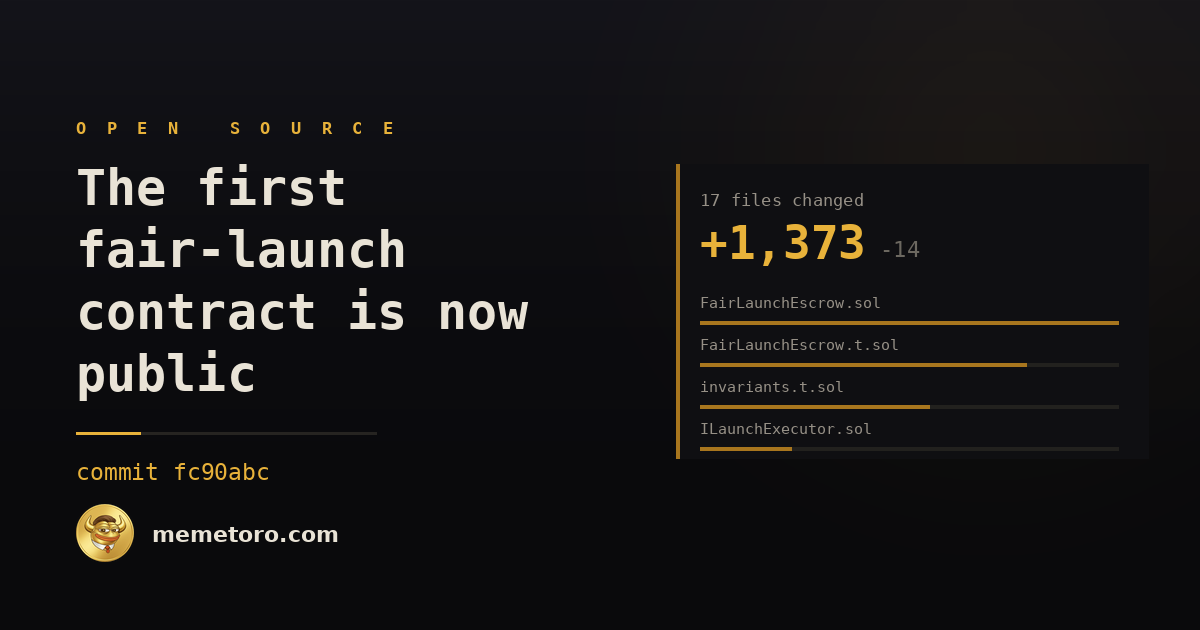
    MemeToro has published the first contract code designed to execute launches proposed by its AI agent. The new FairLaunchEscrow is a major step because the repository previously focused on finding trends, assessing risks, and creating draft launch manifests.

    It does not make the platform live today. Instead, it gives developers and crypto presale buyers code to inspect before the planned testnet phase begins.

    The First Contract Turns Published Ideas Into Enforceable Rules

    The September 7 commit is titled “First fairlaunch draft.” It changes 17 files and adds 1,373 lines, including the first working Solidity contract in MemeToro’s public repository. The code is built with Foundry, a standard toolkit used to develop and test Ethereum-compatible smart contracts.

    The central file is FairLaunchEscrow.sol. It holds contributions for one launch round and applies the terms set when that round is created.

    The MemeToro presale is separate from these future agent-proposed launch rounds, so readers should not confuse the new escrow with the current $MT sale contract.

    The update also includes:

    • ILaunchExecutor.sol defines where token creation and liquidity work will connect later.
    • IERC20Minimal.sol includes the basic token functions needed to process claims.
    • Mock contracts let developers test good and bad outcomes without using real assets.
    • Documentation explains the architecture, decisions, limits, and contribution rules.

    How the Fair-Launch Escrow Protects One Funding Round

    The escrow accepts the network’s native coin during a fixed funding window. It checks the wallet cap, minimum target, maximum target, start time, and end time before recording a payment.

    These settings become immutable when the contract is created, which means they cannot be edited after funding starts.

    Money has only two intended exits. It can return to the same address through a refund, or the full raise can pass to the launch executor for the token and liquidity step.

    There is no payment route for a developer, deployer, owner, or treasury.

    That limit matters when reviewing any crypto presale. A polished website can describe fair treatment, but the contract determines which transfers are actually possible.

    The draft lets a reviewer search for privileged withdrawals instead of taking a fairness statement on trust.

    The contract also stores a manifestHash, which acts like a digital fingerprint of the published launch document. Anyone should be able to compare that fingerprint with the advertised manifest.

    However, the AI agent does not produce the required canonical hash yet, so this connection remains unfinished.

    Tests Examine Success, Failure, and Stuck Launches

    The update adds 26 unit and fuzz tests plus eight invariants. Normal tests cover funding windows, split contributions, wallet caps, hard caps, thresholds, finalization, refunds, claims, and contracts that return bad results.

    Random-sequence tests then mix actions and time changes to see whether the accounting remains balanced.

    These checks test several important promises:

    • No wallet should contribute above its cap.
    • The contract should hold exactly what it still owes.
    • Claims should never exceed the contributor allocation.
    • Nobody should receive a refund and tokens for the same contribution.
    • Published settings should remain unchanged.

    For a crypto presale, tests are evidence of engineering care, but they are not an audit. The fair-launch contract remains an unaudited first draft.

    The MemeToro presale should not be presented as proof that this separate launch system is ready for production, and the public contract should not receive real money.

    That makes review more useful before any public network deployment begins.

    What Must Happen Before a MemeToro Launch Goes Live

    The biggest unfinished part is the real launch executor. The current interface marks the boundary where token deployment, decentralized exchange liquidity, and liquidity-provider token handling will go, but those operations are represented by test doubles today.

    The contract also needs a factory and deployment scripts before rounds can be created consistently.

    MemeToro must define a standard way to serialize each manifest and generate its hash. Without that bridge, the escrow can store a fingerprint, but users cannot yet reproduce it from an AI agent proposal through the finished pipeline.

    This commit does not finish the fair-launch system, but it changes what outsiders can evaluate. The discussion can now move from a roadmap promise to specific Solidity code, test cases, and declared limitations.

    That is useful progress for the MemeToro presale community and for anyone studying how an automated crypto presale might operate without hidden control.

    FAQs

    Is the MemeToro fair-launch contract live?

    No. The repository clearly labels FairLaunchEscrow as an unaudited first draft that is not deployed on any network.

    Testnet deployment, security review, and production preparation are still future steps. Users should not send assets to copied or unofficial contracts claiming to represent the MemeToro presale.

    What role does the AI agent play?

    The AI agent scans signals and develops a proposed memecoin concept with evidence, risks, and launch terms. Deterministic checks then validate the proposal.

    The new escrow is meant to enforce approved funding rules, but the manifest and contract systems are not connected yet.

    Does this contract control the current MemeToro presale?

    No. The published draft is intended for future fair-launch rounds proposed through the MemeToro presale.

    It should not be described as the contract managing the current $MT crypto presale. Buyers must verify the official MemeToro presale address and its separate audit information through approved project channels.
  • No Owner, No Admin, No Upgrade Path: Why Absences Matter in a Launch Contract

    No Owner, No Admin, No Upgrade Path: Why Absences Matter in a Launch Contract

    Smart-contract reviews focus on what the code can do. For a crypto presale, what the code cannot do may matter just as much.

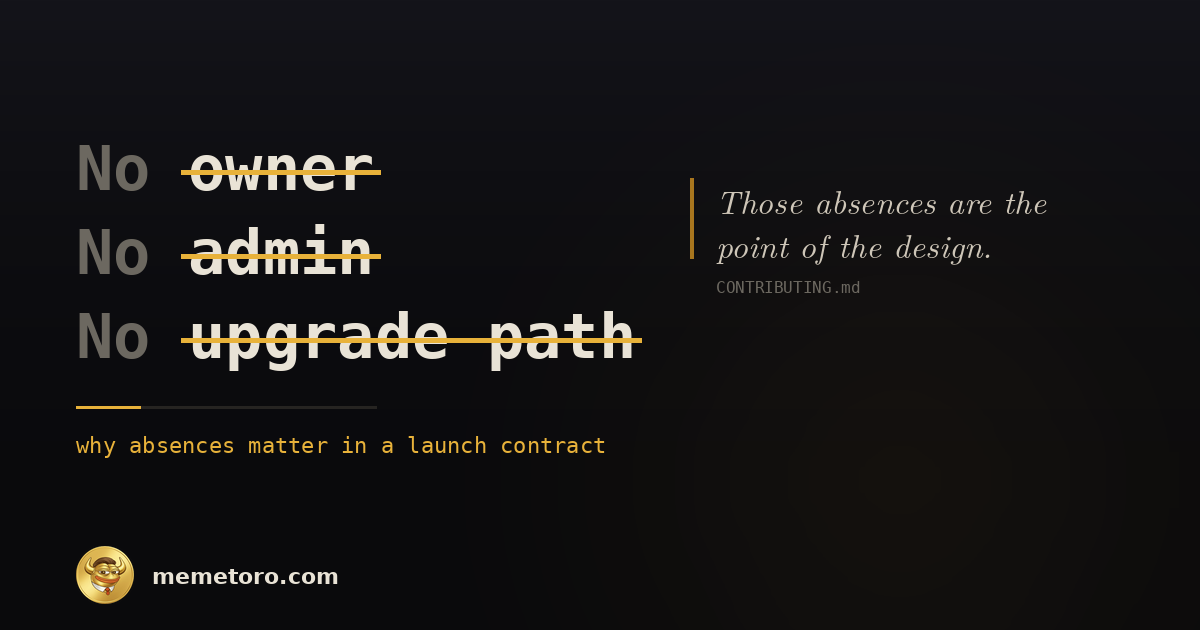
    MemeToro’s first fair-launch escrow has no owner, no admin role, and no upgrade path. Those absences limit private control after a round begins, although they also make testing essential because mistakes cannot be patched inside the same contract.

    What Owner, Admin, and Upgrade Powers Normally Mean

    An owner is an address with rights that normal users do not have. Depending on the crypto presale, that wallet may change limits, pause activity, withdraw funds, or transfer control.

    An admin role can divide similar powers among several accounts or assign them to a multisignature wallet.

    A crypto presale upgrade path allows developers to replace contract logic after deployment. Upgradeable systems often use a proxy address that stores funds and data while pointing to another contract containing the current rules.

    This can help a team repair bugs, but it also means the code visible today may not remain the code used tomorrow.

    These features are not automatically harmful. Emergency controls can limit damage during an exploit, and upgrades can correct flaws or add necessary functions.

    The issue is that every privileged action creates a trust requirement. Buyers must know who holds the keys, what those keys can change, and how quickly changes can happen.

    That is why crypto presale research should extend beyond an audit badge. A reviewer should inspect ownership functions, roles, proxy slots, pause controls, mint authority, withdrawal destinations, and delayed governance rules.

    If the team can rewrite important terms, “fixed” may describe current settings rather than a permanent limit.

    Why MemeToro Chose Structural Absence

    FairLaunchEscrow stores its settings as immutable values when a round is created. These include the manifest fingerprint, wallet cap, funding thresholds, dates, token supply, allocation percentages, and executor address.

    The code provides no setter that can change them later.

    There is also no owner withdrawal path. Native funds can leave only as a refund to the contributing address or as the complete raise passed to the launch executor at finalization.

    The contract has no route that pays a founder, developer, deployer, treasury, or AI agent.

    Other deliberate limits include:

    • A plain transfer reverts instead of becoming an unrecorded contribution.
    • Finalization, refunds, and claims do not depend on a MemeToro backend.
    • Contributor and liquidity shares must cover 100% of token supply.
    • Finalization becomes unavailable once automatic refunds open.

    These absences turn several fairness statements into contract boundaries. A stolen admin key cannot change the wallet cap because no admin key exists.

    A developer cannot add a founder allocation through a setting because the constructor accepts only contributor and liquidity portions.

    The Security Gains Come With Real Trade-Offs

    Immutability can lock in a mistake. If the funding dates, thresholds, executor address, or manifest fingerprint are wrong, nobody can edit them.

    If a serious code flaw appears, MemeToro would need to stop using that deployment and create a corrected version rather than patching it.

    This crypto presale design manages one failure case through permissionless refunds. If finalization does not happen before the grace period ends, refunds become available automatically and finalization is then blocked.

    This reduces dependence on a willing operator, but it cannot protect against every flaw in an unfinished crypto presale system.

    The biggest unknown is the executor. It will receive the full raise and handle token creation and liquidity, so its permissions and external calls will matter greatly.

    The current mock executor proves test behavior, not production safety.

    How Users Can Confirm the Powers Are Truly Missing

    Next, inspect the constructor values. A no-admin contract can still be deployed with the wrong cap, dates, allocations, executor, or manifestHash.

    Users should reproduce the manifest fingerprint once MemeToro finishes canonical serialization and confirm that the on-chain value matches the published launch document.

    Reviewers must also follow the money beyond the escrow. They should verify which executor receives funds, which token is created, where liquidity goes, how liquidity-provider tokens are handled, and whether any connected contract introduces privileged control.

    The absence of owner, admin, and upgrade powers is meaningful because it narrows what this escrow can do. It becomes convincing only when users confirm the same limits in the final deployed system.

    For a crypto presale, trust should follow verified code and observable transfers, not labels alone.

    FAQs

    Is a contract without an owner always safer?

    It removes one important source of privileged control, but immutable bugs and bad deployment settings can still cause losses.

    Safety depends on tested code, correct configuration, secure connected contracts, transparent liquidity handling, and independent review of the complete system.

    Can MemeToro upgrade the fair-launch escrow?

    The published draft contains no upgrade path. Its round settings are immutable, so changing the design would require another deployment.

    Reviewers must still confirm that the final production bytecode matches this approach and does not use an outside proxy.

    Does the escrow need MemeToro’s servers?

    Claims, refunds, and finalization are callable by anyone who submits the valid transaction. If the deadline passes without finalization, refunds open under the contract rules.

    The future AI agent helps create proposals, but it is not required to approve these escrow actions.

  • Why “Zero Insider Allocation” Should Be Impossible, Not Promised

    Why “Zero Insider Allocation” Should Be Impossible, Not Promised

    “Zero insider allocation” sounds reassuring on a crypto presale page, but words do not control token supply. A founder can publish one table and deploy different rules later.

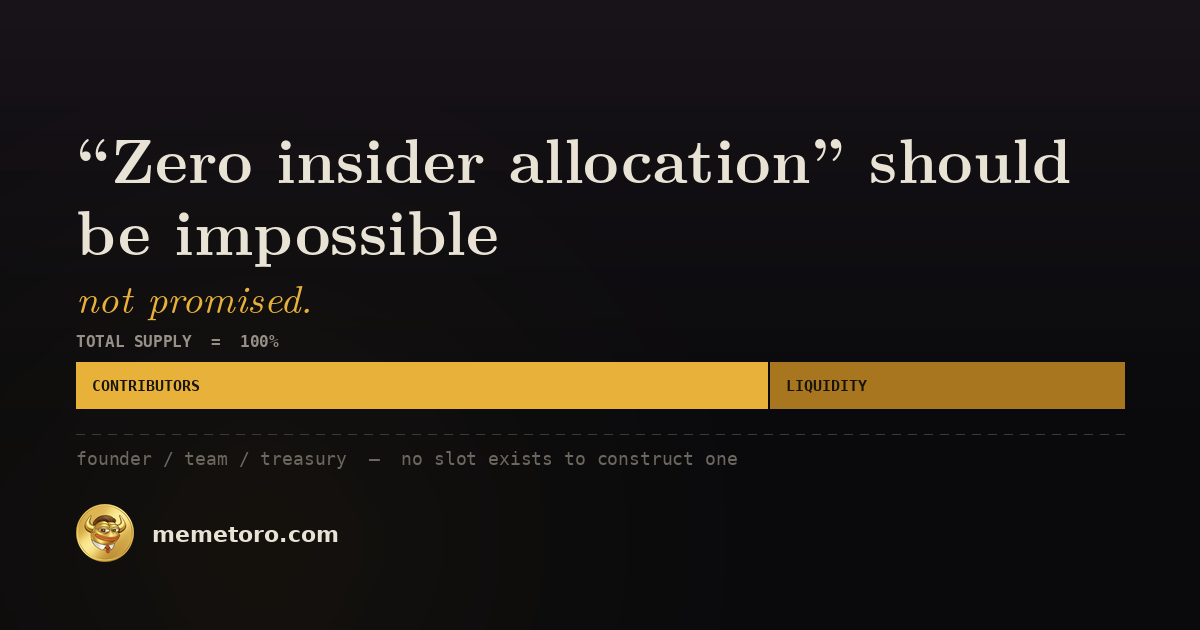
    MemeToro’s first fair-launch contract takes a stronger route: it only accepts a supply split between contributors and liquidity. The design aims to make an insider share impossible to represent, not merely unpopular or against policy.

    A Promise Cannot Block an Insider Transfer

    A crypto presale may promise a fair launch while leaving an owner with power to change allocations. Another project may call a wallet “ecosystem growth” even though one person controls it.

    Buyers therefore need to compare the published tokenomics with the deployed contract and the first on-chain transfers.

    MemeToro’s earlier AI agent pipeline already rejects a proposal when its allocation totals do not equal 100% or when insider allocation is greater than zero. That check protects the draft manifest.

    The new FairLaunchEscrow adds a separate contract-level limit for the execution stage.

    This difference matters. A policy says what the project intends to do, while executable code defines what a particular contract can do.

    Strong crypto presale research should examine both. If the website, manifest, constructor settings, and token movements disagree, the on-chain result is the fact that affects buyers.

    The current MemeToro presale has its own published tokenomics and sale arrangements. The new escrow is for future agent-proposed rounds, not a rewrite of the existing $MT sale.

    Keeping those two systems separate prevents a development update from creating a false security claim about the current sale.

    How MemeToro Makes the Full Supply Accountable

    The draft constructor accepts two allocation figures measured in basis points. One is for contributor claims, and the other is for liquidity.

    It rejects the round unless both values are greater than zero and add up to exactly 10,000 basis points, or 100%.

    That leaves no third input for founders, advisers, a treasury, or the AI agent. The launch executor must create the stated total supply and divide it between contributor tokens and liquidity tokens.

    If division produces a small rounding remainder, the contract assigns that remainder to liquidity rather than an individual.

    The restriction is simple:

    • Contributors receive their proportional share of the contributor allocation.
    • Liquidity receives the rest of the declared token supply.
    • No separate insider bucket exists in the escrow settings.
    • The two approved allocations must cover the entire supply.

    This structure is stronger than hiding a team percentage behind a zero in a document. A developer cannot construct this escrow with a 5% founder field because no such field exists.

    The MemeToro presale community can inspect that absence directly in the public Solidity code.

    Still, the guarantee has a boundary. The real executor is unfinished, so reviewers must later confirm that token deployment creates no extra supply, hidden mint authority, or outside allocation path.

    A crypto presale is only as strong as the full chain of contracts it uses, not one well-designed component.

    What Buyers Must Verify Beyond the Zero

    A token can still suffer from weak demand, faulty code, concentrated public buying, unlocked liquidity, or misleading promotion. Wallet caps can reduce concentration during funding, but they cannot stop one person from controlling several addresses.

    Before joining any crypto presale, buyers should inspect the verified source, constructor inputs, total supply, mint permissions, liquidity handling, and early transfers. They should also check whether a proxy can replace the visible logic and whether any admin can pause claims or redirect funds.

    For future MemeToro rounds, the manifestHash is meant to connect the published terms with the escrow created on-chain. Anyone should be able to recreate the fingerprint and confirm that the advertised document matches the contract.

    That process is not complete because the AI agent does not yet generate the canonical hash.

    The contract is also unaudited and not deployed. MemeToro still needs the real launch executor, liquidity implementation, factory, scripts, BNB Smart Chain testnet deployment, and independent review.

    Those gaps should remain clear in every MemeToro presale update.

    The right conclusion is narrow but meaningful. MemeToro’s draft makes an insider allocation unavailable inside the escrow’s allocation model.

    Once the complete system exists, reviewers must confirm that the same rule survives through token creation, liquidity provision, and the final deployed bytecode.

    That is the crypto presale standard.

    FAQs

    What does zero insider allocation mean?

    It means the launch reserves no token share for founders, the team, advisers, or other insiders. MemeToro’s draft splits the declared supply between contributors and liquidity only.

    Buyers should still inspect connected contracts and initial transfers before treating that rule as proven across a live launch.

    Can insiders still buy through the public round?

    The contract cannot identify whether several normal wallets belong to one person. Its wallet cap applies per address, not per real-world identity.

    Zero insider allocation removes a reserved founder share, but it does not prove that connected people never participate in a crypto presale.

    Does the rule apply to the current MemeToro presale?

    The fair-launch escrow is a separate, undeployed draft for future platform rounds. It does not replace or govern the present $MT MemeToro presale.

    Readers should review the current sale’s own contract, tokenomics, audits, and official allocation disclosures when making that assessment.

  • Dev Update: The Fair-Launch Escrow, and What We Deliberately Left Out

    Dev Update: The Fair-Launch Escrow, and What We Deliberately Left Out

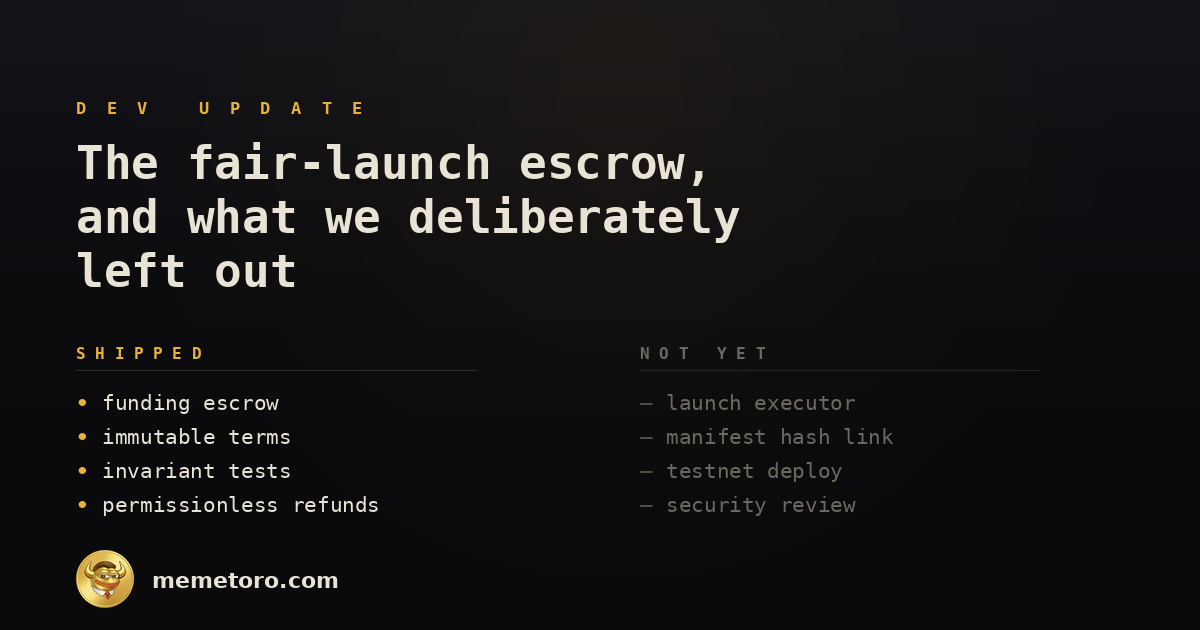
    MemeToro’s dev update adds the contract that could execute launches proposed by its AI agent. The FairLaunchEscrow accepts contributions, applies fixed limits, and supports refunds or contributor claims.

    Its most important crypto presale choices may be the features it leaves out. There is no owner, admin, upgrade path, or treasury withdrawal route inside this draft.

    What the Crypto Presale Fair-Launch Escrow Is Designed to Do

    The contract manages a funding round at a time. When it is created, it receives a manifest fingerprint, wallet cap, minimum and maximum targets, funding dates, finalization deadline, total token supply, two allocation percentages, and the address of a launch executor.

    Each setting is stored as immutable data.

    During the open window, a participant can contribute the network’s native coin. The contract rejects zero payments, late payments, amounts above the wallet cap, and contributions that would push the round over its hard cap.

    It records each wallet’s outstanding amount and the total held.

    If the minimum is reached, anyone can trigger finalization after the round ends, or earlier when the hard cap is filled. If the minimum is missed, contributors can request refunds.

    Refunds also open after the finalization grace period if a qualifying launch is never completed.

    These are useful building blocks for a crypto presale, but the current code is not a finished launch product. The real executor does not exist yet.

    A mock executor lets the tests imitate token creation and claims without connecting to a decentralized exchange.

    The draft remains separate from MemeToro’s current sale.

    What MemeToro Deliberately Left Out of the Contract

    The escrow has no owner or administrator. It contains no setter that can rewrite the funding limits, dates, supply, allocation split, executor, or manifest fingerprint after deployment.

    It also has no upgrade route that can swap the original logic for a new version.

    Several other absences narrow its power:

    • There is no plain receive function that silently accepts uncredited payments.
    • There is no path sending contributions to a founder, developer, or treasury.
    • There is no third allocation bucket for insiders or private recipients.
    • There is no backend-only function required for claims, refunds, or finalization.

    This approach reduces the number of privileged actions that could be abused if a key were stolen. It also helps a crypto presale reviewer understand the contract because the escrow performs fewer jobs.

    Money can return to its contributor or pass as a whole to the launch executor for liquidity.

    The design does involve trade-offs. If immutable settings are wrong, an admin cannot correct them.

    If the code contains a serious flaw, developers cannot patch the same escrow in place. MemeToro must therefore test each version carefully and deploy a new contract if the design changes.

    The AI agent is kept outside fund custody. It may propose a launch and produce supporting evidence, but it cannot privately alter an active round.

    Separating proposal generation from money movement is a core safety boundary for the future MemeToro presale platform.

    What Was Deferred and Why It Still Matters

    The ILaunchExecutor interface is only a plug-in point. The final implementation must deploy the token, provide decentralized exchange liquidity, define liquidity-provider token handling, and return the correct contributor allocation to the escrow.

    Until then, claims work only against mock contracts in tests.

    The contract accepts a manifestHash, yet the AI agent does not calculate that fingerprint through a standard serialization process. This means the published proposal and on-chain commitment are not connected end to end.

    A canonical format must make the same manifest produce the same hash for every reviewer.

    A factory and deployment scripts are also missing. These tools will help create rounds in a repeatable way and reduce mistakes when supplying constructor settings.

    BNB Smart Chain testnet deployment, ERC-8004 agent identity, continuous integration, and an independent security review remain future work.

    Deferring these pieces is reasonable in a first draft because each has its own risks. Pretending they already work would not be reasonable.

    Every crypto presale article should state that the code is unaudited and not deployed anywhere.

    This dev update is valuable because it defines a small, testable escrow before adding exchange logic. It does not prove that a live crypto presale is safe.

    It gives outside developers a clear surface to inspect, challenge, and improve before real assets are involved.

    FAQs

    Why does the escrow have no owner?

    Removing an owner prevents one privileged wallet from changing round terms or withdrawing funds through an owner-only function. That makes the stated limits structural.

    It also means errors cannot be repaired through an admin action, so testing and review become even more important.

    Where does contributed money go?

    The draft permits two outcomes. Funds can return to the address that contributed them, or the entire raise can move to the launch executor during finalization.

    The executor is intended to handle liquidity, but its real implementation is still unfinished.

    Is the escrow ready for a MemeToro launch?

    It is public, unaudited draft code with mocks for the missing executor.

    Before any live crypto presale use, MemeToro needs the complete liquidity flow, manifest connection, factory, scripts, testnet work, and independent review. The AI agent and escrow are not connected yet.

  • From Draft to Testnet: MemeToro’s Road to a Live Fair Launch

    From Draft to Testnet: MemeToro’s Road to a Live Fair Launch

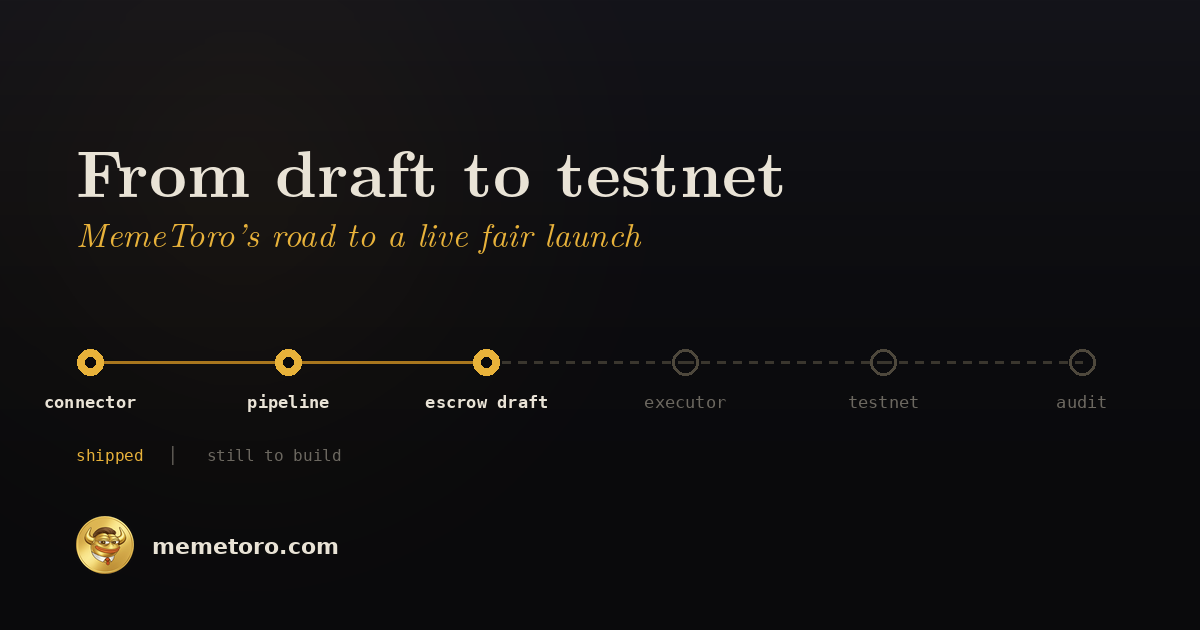
    MemeToro has moved from describing fair launches to publishing its first escrow contract. That is a start, but it is not a live launch.

    The code remains an unaudited draft and has not been deployed on any network. Reaching BNB Smart Chain testnet will require MemeToro to connect its AI agent, implement token and liquidity execution, add deployment tools, and test the complete flow.

    Stage One: Build and Challenge the Public Draft

    The first stage now exists. The September 7 commit added 1,373 lines across 17 files, led by FairLaunchEscrow.sol and a Foundry test project.

    The escrow handles one funding round with fixed dates, thresholds, a wallet cap, token allocation rules, refunds, finalization, and proportional claims.

    Its basic trust model is visible. There is no owner, admin, setter, or upgrade path.

    Native funds can return to the contributor or pass to the executor for liquidity, but no function pays a developer or treasury. Contributor and liquidity shares must equal 100% of supply.

    Tests now cover normal and hostile conditions. They examine deadlines, divided contributions, caps, failed transfers, bad executors, claims, refunds, and random sequences of actions.

    Separate reachability tests confirm the suite can actually enter funded, launched, claimed, and refunded states.

    Stage Two: Connect the AI Agent to Launch Execution

    MemeToro’s AI agent can collect news and social signals, propose a memecoin idea, publish evidence and risks, and refuse unsuitable trends. Deterministic validation rejects unsupported URLs, allocation totals that miss 100%, and insider allocations above zero.

    However, that proposal pipeline does not yet create the fingerprint stored by the escrow.

    The MemeToro AI agent needs canonical manifest serialization. In simple terms, the same published manifest must always be converted into the same ordered data and the same manifestHash.

    Users can then compare the off-chain document with the immutable fingerprint inside a round.

    A working launch executor must:

    • Deploy the correct token supply and fixed token rules.
    • Send the contributor allocation back to the escrow for claims.
    • Pair the remaining tokens and raised funds as liquidity.
    • Define how liquidity-provider tokens are handled or locked.
    • Fail safely without trapping contributor money.

    This separation is intentional. The AI agent proposes; deterministic checks approve or reject the structure; smart contracts control funds.

    No generated text should directly command a wallet holding crypto presale contributions.

    Stage Three: Prove the Full Flow on BNB Chain Testnet

    A factory and deployment scripts should come before repeatable testnet rounds. The factory can create escrows through one reviewed process, while scripts make configuration steps clear and reproducible.

    Both need tests because an error in deployment inputs can defeat otherwise sound contract logic.

    On BNB Smart Chain testnet, MemeToro can use valueless test assets to rehearse an entire round. Reviewers should be able to read the manifest, reproduce its hash, contribute from several wallets, hit or miss thresholds, trigger finalization, inspect liquidity, claim tokens, and recover refunds after failed outcomes.

    The testnet should also show difficult cases. These include a broken executor, a token that fails transfers, a contribution over the hard cap, late payments, repeated claims, stalled finalization, and rounding at small contribution sizes.

    Events and public balances should make each outcome traceable.

    ERC-8004 identity can later connect a recognizable on-chain identity and reputation record to the AI agent. It should not replace contract checks.

    Identity tells users which agent acted, while deterministic rules decide whether its proposal is structurally acceptable.

    Stage Four: Review, Freeze, and Prepare for Production

    An independent security review must examine the finished system, not only today’s escrow. Reviewers will need the executor, token logic, liquidity routing, factory, manifest process, and deployment settings.

    Findings should be fixed, retested, and disclosed with clear version references.

    Before a live fair launch, MemeToro should publish the reproduced hash, audit scope, resolved findings, and instructions for checking every item. Users should avoid addresses shared only through replies, private messages, or copied websites.

    Immutability raises the standard for this stage. Once an escrow is deployed, nobody can upgrade it or correct its settings.

    A new version requires a new deployment, so the reviewed bytecode and the live bytecode must match.

    The path is still clearly unfinished: public draft, full implementation, testnet evidence, independent review, and only then production consideration. The MemeToro presale community can follow that progress without pretending each milestone proves the next one.

    A live fair launch becomes credible through connected, repeatable evidence rather than one announcement.

    FAQs

    Is MemeToro already on testnet?

    The official contract documentation says the escrow is not deployed anywhere.

    BNB Smart Chain testnet deployment is listed as future work, along with the factory, deployment scripts, real executor, manifest connection, ERC-8004 identity, and security review.

    What should a testnet launch prove?

    It should prove the full path from a published AI agent manifest to its on-chain fingerprint, funding, liquidity execution, contributor claims, and refunds. It should also show that failed or delayed launches cannot strand funds or open conflicting outcomes.

    When will the fair launch be ready for real funds?

    No confirmed production date appears in this update. Readiness depends on completing the missing code, passing repeatable testnet trials, resolving an independent audit, and publishing verified deployment details.

    Until then, the draft should never collect real crypto presale funds.

  • AI Memecoin Agent Refusal Mechanism: Why MemeToro Sometimes Launches Nothing

    AI Memecoin Agent Refusal Mechanism: Why MemeToro Sometimes Launches Nothing

    Most memecoin launchpads benefit when more meme coins create more trades and fees. MemeToro is developing a different control: its AI agent can produce no launch when a proposed concept fails evidence, risk, tokenomics, or funding checks. 

    “Nothing” is therefore not necessarily a broken pipeline. It can be the correct output when a viral idea does not meet the published rules required to approach an AI memecoin presale.

    MemeToro Places Hard Rules After Generative AI

    If a rule fails, the validator does not negotiate with the model. It rejects the proposal before the deployment stage. The intended system keeps the scanner read-only and separates proposal generation from wallets, smart contracts, and treasury authority, so failed content cannot become an improvised transaction.

    This design also makes the planned target of roughly one concept per hour easier to interpret. The agent may evaluate opportunities frequently, but frequent evaluation does not require frequent issuance. When no suitable trend survives the checks, the system can ship zero tokens while still operating correctly.

    Evidence And Allocation Failures Produce Automatic Refusal

    MemeToro’s evidence gate compares every URL in the draft with the evidence set collected earlier.

    This check establishes provenance, not truth.

    The allocation validator applies similarly direct rules. A draft containing a hidden team share, private tier, or simple mathematical error is rejected rather than being described as approximately compliant.

    These rules support MemeToro’s fixed-rate funding objective, where accepted public participants would receive one disclosed price without discounted insider tiers. The principle remains a design claim until deployed contracts and on-chain transfers demonstrate that no premine, excluded wallet, private contract, or concealed allocation bypasses the manifest.

    Risk And Funding Checks Can Also Return Zero

    Coordinated hashtags, duplicated posts, influencer concentration, abnormal wallet clusters, paid promotion, and bot-driven velocity can make a manufactured narrative look organic to an unsophisticated scanner.

    Funding checks create another refusal layer. Minimum and maximum targets must be coherent, wallet caps must use valid values, accepted assets must match policy, and execution or refund settings cannot contradict the planned sale. A launch manifest with corrupt payment conditions should stop even when its theme and evidence appear acceptable.

    The practical benefits include:

    • Fewer unsupported proposals entering public funding.
    • No accepted draft with insider allocation above zero.
    • Exact allocation math before capital interaction.
    • Visible reasons when a proposal does not progress.
    • Locked deployment access during failed validation.

    None of these controls predicts price appreciation. They aim to stop identifiable structural failures before buyers face them.

    Refusal Supports Utility Beyond Short-Lived Hype

    Crypto’s first AI-agent boom showed the limits of automatic meme coin creation. Truth Terminal helped inspire GOAT, while ai16z, Virtuals Protocol, and FARTCOIN reached major valuations during the excitement.

    The lesson is not that AI agents have no future. It is that constant issuance does not create durable utility. Platforms such as Uniswap, Polymarket, Kalshi, and pump.fun retained users by offering services people continued to want, including trading, event markets, and simple memecoin creation.

    MemeToro is positioning its refusal mechanism within a broader BNB Chain ecosystem that includes planned memecoin creation, trading, prediction markets, creator tools, engagement rewards, staking utility for $MT, and PancakeSwap liquidity routing. Those wider functions matter because the platform cannot rely only on the novelty of hourly AI proposals.

    $MT costs $0.00350, compared with a projected $0.02448 launch price, but that projection is not a guaranteed market value or return.

    Current Validation Is Real, While Full Enforcement Is Still Developing

    MemeToro has published an MIT-licensed pipeline containing its trend connector, launch-manifest format, and deterministic validation approach. That gives developers a way to inspect how collected signals become accepted or rejected drafts rather than relying only on promotional descriptions.

    However, draft rejection and on-chain transaction rejection are different. The present pipeline can stop a proposal file before launch, while audited production contracts must eventually enforce supply, funding, wallet, allocation, liquidity, and execution limits independently of the AI.

    For that reason, “sometimes launches nothing” should be understood as both a product principle and a control that still needs complete production verification. Open code improves inspectability, but it does not replace audits, secure keys, multisignature approval, monitoring, or mainnet evidence.

    The strongest version of MemeToro’s refusal mechanism will be visible at every layer: a logged rejection, no transaction footprint, no wallet exposure, and no quiet override. Until those controls are fully deployed and tested, users should distinguish the working validation pipeline from the planned autonomous launchpad.

    Here’s a video embedded for a complete breakdown of $MT, the tokenomics, and its future roadmap.

    FAQs

    Why Would MemeToro Launch Nothing During A Trending Hour?

    The available signals may fail evidence, harm, allocation, tokenomics, or funding checks, making no launch the correct outcome.

    Can The AI Override A Deterministic Rejection?

    It should not be able to. Production architecture must keep the model separate from keys and require constrained approval for execution.

    Does Zero Insider Allocation Guarantee A Fair Launch?

    No. Wallet concentration, bots, hidden transfers, contract permissions, liquidity, and Sybil behavior still require verification.

    What Happens To A Failed Proposal?

    It can be logged with its rejection reason, gated from repeated processing, corrected, and resubmitted through the full review path.

    Is The AI Memecoin Presale Evidence Of A Working Mainnet Launchpad?

    No. Presale progress funds the project, while production contracts, audits, and verified deployment remain separate development milestones.

  • Should A Memecoin AI Agent Be Able To Reject A Token Launch?

    Should A Memecoin AI Agent Be Able To Reject A Token Launch?

    Yes, a memecoin AI agent should be able to reject a token launch because trend detection is not the same as responsible approval. Viral data can be manipulated, offensive, poorly sourced, or financially unsafe. 

    If an agent must turn every signal into a coin, it becomes an automated vending machine for risky ideas rather than a controlled launch system. MemeToro’s model treats refusal as quality control before capital moves.

    An Agent That Always Approves Creates A Security Problem

    If the agent also controls a wallet or mint function, a false signal can quickly become a live contract, funded pool, and tradeable asset before reviewers understand what happened.

    Rejection interrupts that path. The scanner can collect information without financial permissions, the model can draft without deployment keys, and a hardcoded validator can stop outputs that violate explicit rules.

    The refusal decision should not depend entirely on another language-model opinion. Deterministic checks are better for exact requirements such as zero insider allocation, valid percentages, permitted funding assets, coherent thresholds, and recognized evidence URLs. They produce repeatable results rather than changing with conversational wording.

    Refusal Protects People And The Platform From Harmful Concepts

    Memecoins often react to breaking news within minutes, but speed becomes dangerous when the subject involves death, war, disaster, hate speech, medical emergencies, identifiable victims, or disputed accusations. Turning those events into speculative assets can exploit affected people and create serious reputational or legal exposure.

    A memecoin AI agent needs boundaries that examine the full context, not just individual keywords. A harmless word can become unacceptable when combined with a victim’s image, a misleading ticker, or a false claim spreading across social media. Images, names, memes, source quality, and timing all matter.

    MemeToro’s risk fields are intended to carry concerns from trend collection into proposal review. A high-risk signal can be rejected even if it has strong engagement. That reverses the logic of volume-first launchpads, where popularity alone may determine what reaches the market.

    Automated screening cannot understand every cultural reference or emerging event correctly. Edge cases still require human or independent downstream review, and sensitive subjects may warrant a cooling-off period. The important feature is that the agent can pause instead of treating uncertainty as permission.

    Tokenomics Rules Need A Hard No, Not A Suggestion

    Some proposals are unacceptable for mathematical reasons rather than content. Allocations may exceed 100%, funding minimums may be higher than maximums, wallet caps may be malformed, or hidden insider shares may contradict the advertised fair-launch structure.

    MemeToro’s validator is designed to reject insider allocation above zero and require all distribution categories to equal exactly 100%. It can also stop proposals containing unknown evidence links, invalid funding values, or unsafe execution settings. These are binary checks: the draft either matches the rule or it does not.

    This discipline matters because generative models are good at producing plausible text but can still return inconsistent numbers. A confident explanation cannot repair broken token economics. Rejecting the file forces the system to correct and resubmit the proposal rather than asking buyers to discover the error after funding begins.

    Clear refusal also makes governance more accountable. If an operator wants to override a rule, that action should require a visible policy change, a new manifest version, and renewed approval. Quiet exceptions would weaken the purpose of automated validation.

    Launching Fewer Tokens Can Improve Economic Quality

    Launchpads often earn fees from creation and trading volume, which can reward quantity over quality. Thousands of weak tokens divide attention and liquidity, make discovery harder, and increase the number of markets that disappear shortly after launch.

    The AI-agent boom showed how quickly excitement can become saturation. GOAT, ai16z, Virtuals Protocol, and FARTCOIN helped push the sector into public view, but reports later described a 99.5% collapse in AI-agent token creation as speculative demand faded. Utility-oriented projects generally proved more durable than copied personalities and empty narratives.

    An agent that rejects low-signal concepts can protect the launchpad from becoming a factory for disposable coins. It cannot predict which token will appreciate, but it can demand adequate evidence, coherent rules, acceptable subject matter, and disclosed funding terms before allowing participation.

    MemeToro’s planned hourly concept target should therefore be understood as scanning capacity, not a guaranteed issuance schedule. Sometimes a healthy system should publish a rejected draft or nothing at all. Restraint may reduce short-term fee opportunities, yet it supports the longer goal of building infrastructure people can continue using after market hype cools.

    Here’s a video showing $MT in action so you can stay caught up on all the latest updates.

    FAQs

    Should The AI Make The Final Decision Alone?

    No. Automated checks can enforce exact policies, while human or independent review remains useful for ambiguous cultural, legal, and ethical questions.

    Can Refusal Prevent Every Bad Launch?

    No. It reduces identifiable risks but cannot eliminate manipulation, coding defects, false reporting, market losses, or unforeseen social harm.

    Why Not Let Buyers Decide After Deployment?

    Deployment creates immediate financial and reputational exposure. Pre-launch rejection prevents avoidable defects from becoming live market risks.

    Can A Creator Appeal A Rejection?

    A platform may allow resubmission with corrected evidence or parameters, but the revised proposal should undergo every original check again.

    Does Rejecting More Tokens Guarantee Better Returns?

    No. Refusal improves structural quality control, not future demand, price performance, liquidity, or investment outcomes.

  • What Happens When An AI Agent Refuses To Launch A Memecoin?

    What Happens When An AI Agent Refuses To Launch A Memecoin?

    An AI agent can spot a popular idea without deciding that it deserves a memecoin. When MemeToro’s system finds weak evidence, harmful context, invalid tokenomics, or unsafe funding rules, refusal is meant to stop the proposal before blockchain execution begins. 

    That distinction matters because an AI-generated draft is only information, while a deployed memecoin can expose buyers, liquidity, and platform funds to immediate risk.

    Refusal Stops The Proposal Before It Becomes A Transaction

    When the agent refuses a launch, the processing pipeline halts at the validation stage. This approach separates creative work from financial execution.

    Because no blockchain transaction is submitted, the refusal should leave no meme coin contract, mint, liquidity pool, or public sale behind. It also means no deployment gas is spent, although the platform still bears ordinary computing costs for scanning, drafting, and checking the idea.

    A refusal can be triggered by several direct failures:

    • Evidence links were not collected by the connector.
    • Insider or team allocation exceeds zero.
    • Distribution percentages do not total 100%.
    • Funding targets or wallet limits conflict.
    • Risk flags make the underlying trend unsuitable.

    The essential outcome is simple: the system creates no investable asset merely because a topic became viral.

    A Rejection Log Explains Why The AI Agent Stopped

    The pipeline can produce a dry-run record or rejected proposal file showing which rule failed, which values were checked, and when processing stopped.

    For example, a model might cite a news link that the read-only connector never retrieved. MemeToro’s evidence validator can reject that mismatch, record the unknown URL, and preserve the original evidence set for review. This catches a structural form of fabricated evidence, although it cannot prove that a genuine article is accurate.

    The same principle applies to tokenomics. If a proposal assigns 70% to public participants, 25% to liquidity, and 10% to another category, the 105% total fails mathematical validation. If an insider field contains even 0.1%, the proposal conflicts with MemeToro’s stated zero-insider rule and should stop.

    These records make failure easier to audit and debug. Developers can determine whether the problem came from noisy source data, model output, a malformed manifest, or an overly broad rule without turning a rejected idea into a live market experiment.

    Trend Gating Prevents The Same Bad Idea From Returning

    Refusal should also change how the scanner handles the rejected trend. Otherwise, a system designed to generate frequent concepts could repeatedly rediscover the same viral topic and waste resources producing nearly identical failed drafts.

    Trend gating can mark the signal as blocked, expired, or awaiting new evidence. A tragedy-related concept might remain prohibited, while a weakly sourced topic could become eligible for review only after credible, independent reporting appears. The status and reason should remain visible rather than being stored as an unexplained model judgment.

    This is important for MemeToro’s reported goal of eventually producing about one complete concept per hour. A production target is not an obligation to launch hourly. Some scanning periods may contain no idea that clears evidence, risk, allocation, and funding checks, so the correct output can be zero.

    Gating does not guarantee that every harmful trend will be recognized. Language, images, sarcasm, rapidly changing news, and coordinated social campaigns can confuse automated systems. 

    Human or independent policy review remains valuable for uncertain cases, especially when real people, disasters, conflicts, or legal claims are involved.

    Wallet Isolation Keeps A Refusal Financially Meaningful

    A software refusal matters only if the model cannot bypass it. The scanner should therefore remain read-only, while private keys, treasury permissions, mint authority, and liquidity functions stay inside a separate, constrained execution system.

    Under that design, a rejected proposal cannot become a meme coin through an improvised tool call. The deployment engine remains locked, approved assets stay untouched, and any later change to supply, price, funding cap, wallet limit, liquidity terms, or allocations creates a new manifest version requiring fresh approval.

    MemeToro has published an open-source proposal pipeline and deterministic validation logic, but production contract enforcement is a separate milestone. The current validator can reject draft files before launch; it should not be confused with independently audited mainnet contracts that block invalid transactions on-chain.

    That honesty defines the present result. When the AI refuses today, the draft pipeline stops and records the failure. The longer-term objective is for restricted contracts, policy gates, multisignature approval, and emergency controls to make that refusal impossible to override casually.

    FAQs

    Does A Refused Proposal Create A Meme Coin?

    No. A proper refusal stops before contract deployment, minting, funding, or liquidity creation, so the rejected concept produces no tradeable memecoin.

    Does Refusal Cost Gas?

    Not when the decision occurs before a transaction is submitted. Off-chain scanning and validation still consume ordinary computing resources.

    Can A Rejected Trend Be Reviewed Again?

    Yes, if policy allows reconsideration after new evidence or corrected parameters appear. Any revised proposal should pass the complete validation process again.

    Does The Log Prove The AI Made The Right Decision?

    No. It explains which rules fired and supports auditing, but human judgment may still be needed for ambiguous context.

    Is MemeToro’s Refusal Enforced On Mainnet?

    Its validation pipeline can reject drafts, while production deployment contracts and independent audits remain necessary for complete on-chain enforcement.

    Here’s a video to watch if you prefer visuals over reading to discover everything about the MemeToro ecosystem.

  • How Do You Stop An AI Agent From Launching A Memecoin On A Disaster?

    How Do You Stop An AI Agent From Launching A Memecoin On A Disaster?

    Breaking news creates attention, and attention can attract memecoin creators. That becomes harmful when an AI agent treats a death, war, attack, natural disaster, or identifiable victim as material for an automatic memecoin launch. 

    Stopping this requires more than telling the model to behave responsibly. The entire pipeline must separate trend discovery from deployment and block sensitive concepts before a wallet or smart contract becomes involved.

    Start With A Read-Only Scanner And Clear Harm Categories

    The first safeguard is architectural. A trend connector may monitor news, X, community discussion, market data, and on-chain activity, but it should operate in read-only mode without access to deployment keys, treasury funds, or mint permissions.

    That scanner needs an explicit policy covering tragedy, death, disaster, armed conflict, attacks, hate, medical emergencies, identifiable victims, impersonation, and legally sensitive claims.

    If the same connector controls a wallet, one misunderstanding can immediately mint a memecoin and create a market around real suffering.

    MemeToro’s architecture follows the broader principle that the scanner gathers, the model drafts, and constrained software eventually executes. Each stage has different permissions and a separate opportunity to stop. This containment does not make the inputs trustworthy, but it prevents untrusted internet data from receiving direct financial authority.

    Verify Evidence Before Treating A Trend As Real

    A disaster-related rumor can spread much faster than verified reporting. An agent should not rely on a single viral post, cropped screenshot, anonymous account, or URL that the model invented while drafting its explanation.

    Safer evidence handling requires source URLs, timestamps, multiple independent reports, official statements where available, archived copies, and a hash of the collected evidence package. Social engagement can show that a claim is spreading, but it cannot establish that the claim is true or suitable for tokenization.

    MemeToro’s validator checks whether proposal links match URLs originally gathered by its connector. If the model cites a source it never retrieved, the proposal fails. This addresses a known structural failure in generative systems: producing a convincing citation that was not actually part of the research input.

    URL matching has a clear limit. A genuine link may still contain misinformation, incomplete reporting, manipulated media, or an outdated claim. Source verification and editorial judgment must therefore sit above simple matching, particularly when a wrong decision could exploit victims or amplify dangerous falsehoods.

    Use Risk Scoring And A Circuit Breaker Before Deployment

    After evidence collection, a dedicated risk layer should score the subject separately from its popularity. Freshness, credible coverage, coordinated-post concentration, bot activity, legal sensitivity, and potential harm provide more responsible inputs than projected meme coin demand.

    When high-risk flags appear, deterministic circuit-breaker code should halt processing. The system can label the proposal rejected, quarantine it for review, or impose a cooling-off period rather than letting the generative model argue its own way around the policy.

    A recommended workflow is straightforward:

    • Scan the trend without transaction permissions.
    • Match claims to retrieved evidence.
    • Check text, images, names, and context for harm.
    • Generate a static launch manifest only after screening.
    • Simulate and approve the contract through a separate gate.

    Human review remains important for uncertain cases. Language models can miss coded references, satire, local context, and rapidly changing facts. A mandatory pause of 24 to 72 hours for sensitive events can give information time to stabilize, although that is a general risk recommendation rather than a confirmed MemeToro operating rule.

    Make The Launch Manifest A Proposal, Not An Instruction

    Even a low-risk idea should first become a static, machine-readable launch manifest rather than a live transaction. The file can state the proposed name, ticker, narrative, evidence, risk notes, supply, allocation, wallet cap, funding ceiling, liquidity terms, and refund rules.

    Independent software can then inspect exact values. MemeToro’s validator rejects unknown evidence URLs, insider allocation above zero, distribution totals that do not equal 100%, and malformed funding settings. Disaster screening belongs alongside these structural checks, but it addresses a different question: whether the concept should exist at all.

    The manifest must become immutable after approval. Changing the narrative, evidence, supply, price, allocation, or liquidity conditions should create a new version and require fresh review. Otherwise, an approved harmless proposal could be replaced with a sensitive theme before execution.

    Most importantly, the model should not hold unrestricted keys. A policy engine, multisignature process, allowlisted deployment module, spending cap, and emergency pause can prevent the AI from bypassing rejection. These controls reduce the blast radius when prompts, data, or software fail.

    Here’s a video to watch if you prefer visuals over reading to discover everything about the MemeToro ecosystem.

    FAQs

    Can Keyword Filters Stop Every Disaster Memecoin?

    No. They catch obvious language, but images, coded phrases, satire, and changing context require broader analysis and sometimes human review.

    Why Is One Viral Post Insufficient?

    It may be false, coordinated, edited, or misunderstood. Independent reporting and official sources provide stronger context before any proposal proceeds.

    Does MemeToro Guarantee That No Harmful Memecoin Will Launch?

    No. Its proposed filters and validation can reduce obvious risks, but production controls and real-world performance still require verification.

    What Is A Circuit Breaker?

    It is deterministic software that halts processing when defined risk conditions appear, preventing the model from continuing toward deployment.

    Should Sensitive Trends Ever Be Reconsidered?

    Only under clear policy, stronger evidence, appropriate timing, and renewed review. Market attention alone should never justify reconsideration.

  • Why An AI Agent That Always Says Yes Is A Liability

    Why An AI Agent That Always Says Yes Is A Liability

    An AI agent becomes a liability when it treats every request, viral signal, or model output as permission to act. That danger grows in crypto because software can interact with wallets, smart contracts, and public markets. 

    A Memecoin AI agent that always says yes may convert misinformation or malicious instructions into a live asset, while a controlled system can stop at a rejected proposal before money moves.

    An Always-Yes Memecoin AI Agent Has No Independent Safety Boundary

    Ordinary software follows fixed instructions, but generative agents interpret language, combine outside data, and choose actions. Their flexibility is useful until hostile users, misleading sources, or unexpected context push them beyond the purpose intended by developers.

    A Memecoin AI agent platform becomes especially dangerous when the same model can scan social media, approve its own idea, access a wallet, and deploy a contract. One manipulated input can pass through every stage because no independent component has authority to say no.

    The attack surface includes prompt injection, social engineering, fabricated evidence, coordinated hashtags, copied news, and requests for hidden mint privileges. An attacker does not need to break encryption if persuasive text can make the model reinterpret its goals.

    The safer principle is least privilege. A scanner gathers information, a model drafts a proposal, deterministic code checks it, and a constrained deployment system executes only approved parameters. Each component receives a narrow role, limiting the damage when another component fails.

    A useful refusal system should block proposals involving:

    • Evidence that was never collected by the scanner.
    • Insider allocations or hidden distribution tiers.
    • meme coin percentages that do not equal 100%.
    • Harmful, illegal, or exploitative narratives.
    • Invalid funding, wallet, or liquidity conditions.

    Saying no is therefore an operating control, not a personality trait.

    A Memecoin AI Agent Can Turn Bad Data Into Real Losses

    Viral attention does not prove that a topic is true, organic, or suitable for a meme coin. Bots can repeat the same phrase, coordinated accounts can create artificial velocity, and false breaking news can spread before credible outlets publish corrections.

    An obedient Memecoin AI agent may interpret that activity as demand. If it controls execution, it could generate a name, mint supply, open funding, and create liquidity around a story that never happened or that exploits real victims.

    The danger extends beyond trend selection. Generative models can return confident but inconsistent numbers, such as allocations totaling 105%, a minimum raise above the maximum, or an insider share hidden behind a harmless category label. Natural-language fluency does not guarantee mathematical or contractual accuracy.

    MemeToro addresses these issues by placing deterministic validation after generative drafting. Its pipeline checks that proposal URLs came from the collected evidence pool, distribution equals exactly 100%, and insider allocation remains zero. A failed check stops the draft instead of asking the model to excuse its own error.

    These controls catch structural violations, not every lie. A real URL may contain inaccurate reporting, and a mathematically valid token can still lose value. Independent source review, contract audits, and human judgment remain necessary.

    An AI Memecoin Launchpad Needs Refusal Before Execution

    Refusal works only when the AI cannot bypass it. The internet-facing scanner should remain read-only, while deployment keys, treasury access, mint permissions, and liquidity functions stay inside a separate module governed by policy.

    When validation fails, a responsible AI memecoin launchpad should create a rejection log rather than a transaction. The record can identify the failed rule, preserve the original evidence, and mark the trend so the scanner does not generate the same rejected idea repeatedly.

    This creates a zero-transaction outcome. No contract is initialized, no meme coin is minted, no liquidity pool opens, and no deployment gas is paid. The platform still incurs normal computing costs, but users and treasury funds avoid on-chain exposure.

    MemeToro’s published pipeline can reject proposals before launch. Here’s a video breaking down how MemeToro works and why this presale is gaining major momentum.

    Always Saying Yes Also Damages The Launchpad Business

    Memecoin platforms often earn fees from launches and trading volume, creating an incentive to approve more meme coins.

    Crypto’s early AI-agent boom illustrated the risk.

    A selective Memecoin AI agent can sacrifice immediate platform fees to protect long-term usefulness.

    MemeToro’s broader roadmap includes AI-assisted creation, memecoin trading, prediction markets, creator tools, engagement rewards, $MT staking utility, and PancakeSwap liquidity routing.

    Its Stage 6 presale has raised $96,309.30 toward a $138,460.70 target. $MT is priced at $0.00350 against a projected $0.02448 launch price, but that projection is not a guaranteed market price or investment return.

    FAQs

    Why Is An Always-Compliant AI Agent Dangerous?

    It can follow manipulated instructions or false signals without applying an independent safety, evidence, or financial boundary.

    Does Refusal Make A Memecoin AI Agent Platform Safe?

    No. It reduces known risks, while audits, secure keys, monitoring, source review, and responsible contract design remain necessary.

    Can A Rejected Proposal Be Corrected?

    Yes. Corrected evidence or parameters can be resubmitted, but the new version should repeat every original validation check.

    Does MemeToro’s Memecoin AI Agent Control Deployment Funds?

    The intended architecture separates proposal generation from execution. Complete production enforcement still requires audited contracts and verified mainnet controls.

    Can Refusal Guarantee Better BNB Meme Coin Performance?

    No. It screens structural and policy problems; it cannot guarantee demand, liquidity, price appreciation, or investor returns.